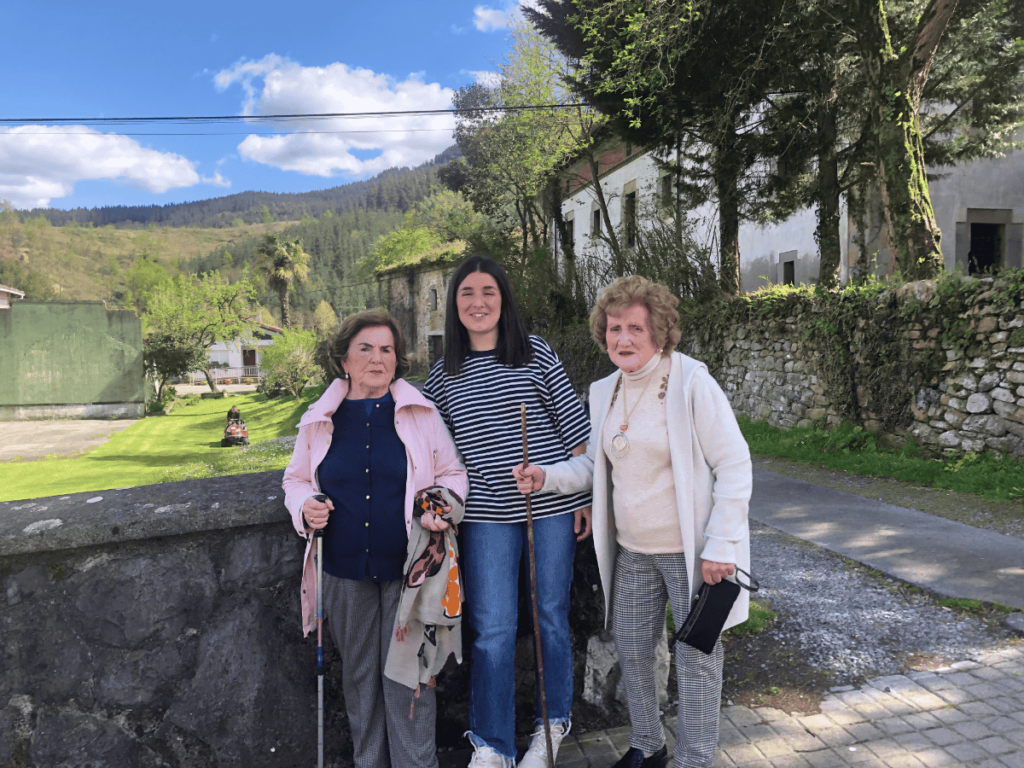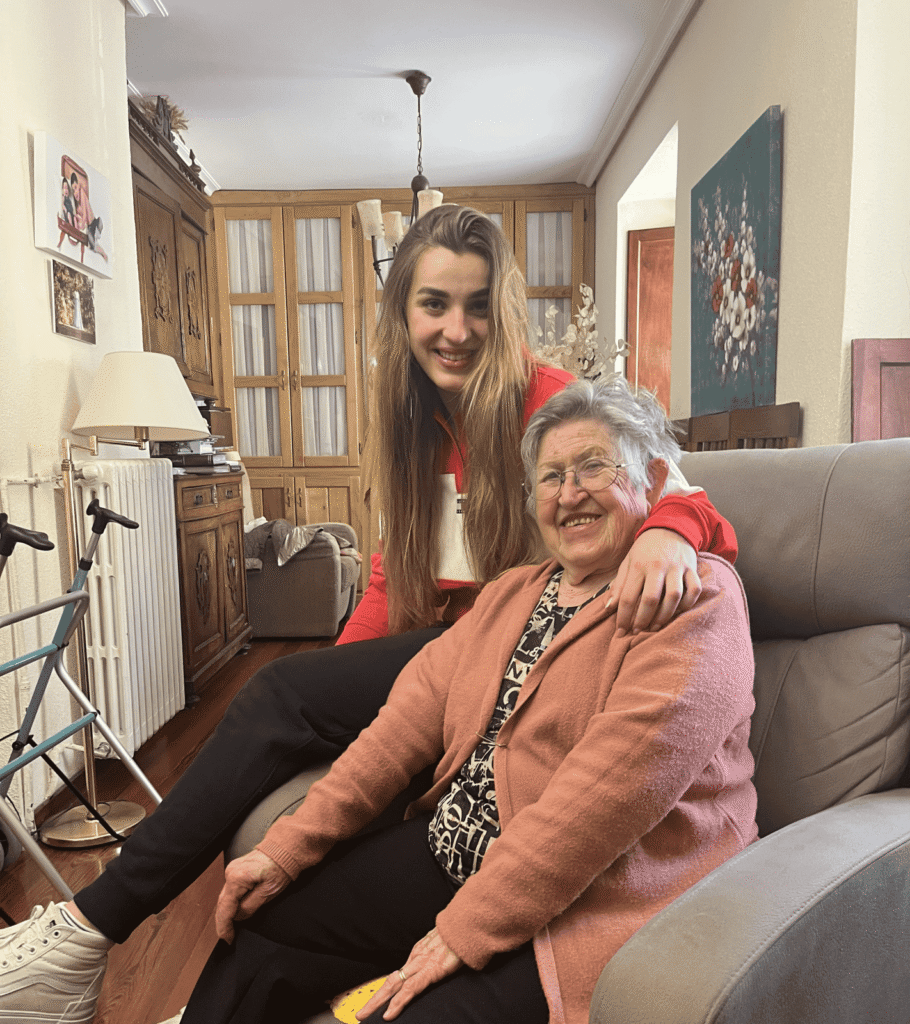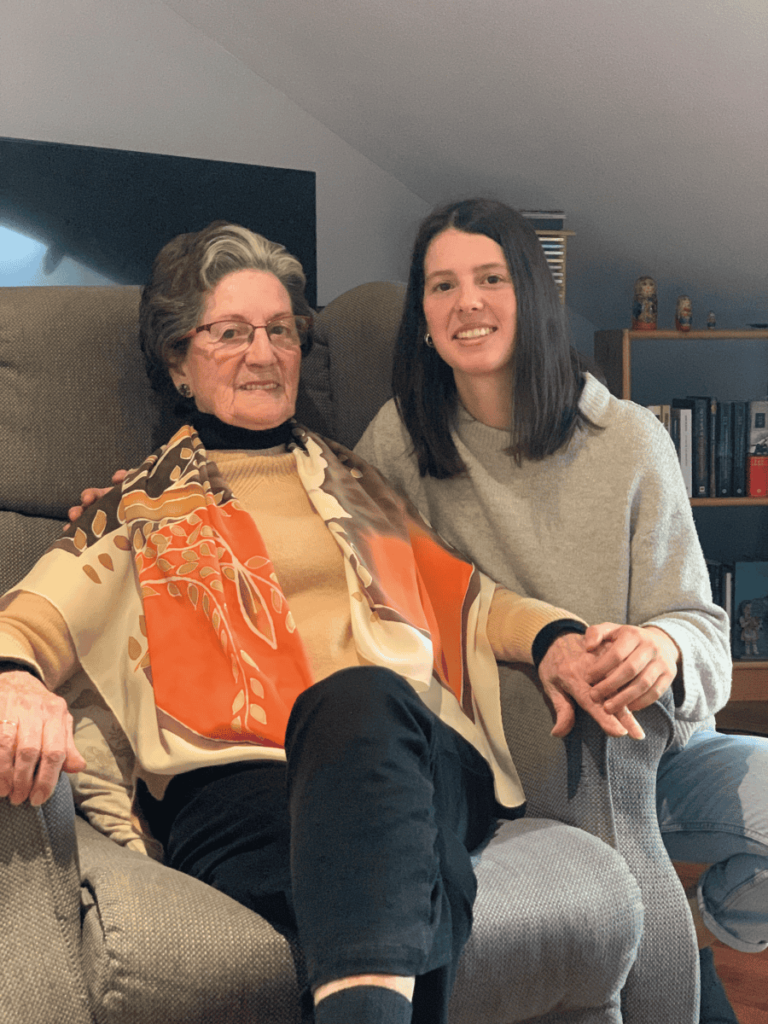
Two and a half kilometers, that’s the distance between Maeztu and Atauri, and vice versa. Mari Luz Olalde Olalde knows this well because she has traveled it hundreds of times throughout her life, on foot, by bike, by motorbike, by car…
His life has been spent mainly between these two points in our geography, in a coming and going in which his family and their care have formed the basis of his existence.

She was born in Atauri, in the middle neighborhood, listening to the nearby sounds of the Ega River. Her mother’s family home welcomed her as what she was, the firstborn child, wanted and loved by all who lived there—a large and close-knit family.
After her came a brother and no one else.
The grandfather and his son Urbano repaired millstones, made mill wheels, and other parts. They traveled throughout the Llanada region and parts of Navarre.

The Atauri Bridge
There was once a bridge in Atauri that connected the two banks of the river. All that remains of it are the memory and the photographs that were taken.
In 1737 it ceased to be an old wooden bridge and became a solid stone bridge, which lasted until the 1990s, when the bridge broke as a truck carrying pigs crossed it, precisely from the last herd of pigs that remained in Atauri.
The asphalt factory
Her father was the postman in Atauri and a carpenter at the asphalt factory. The factory required a lot of mail, Mari Luz recalls. There were also a few farmers in the village, but most of the men worked at the asphalt plant, on the road to Kanpezu, where the train station was located.
Every morning men arrived there from many surrounding villages, most by bicycle or train, “but for example from Korres they came with a donkey.”
Activity was constant in a ravine like Atauri. Everyone worked at the factory: from Aletza, from Maeztu, from Apellaniz, from Antoñana…

“My brother and my husband also went to the factory, like everyone else; he didn’t want to become a friar, to the seminary, so he went to work.”
Life was dictated by the coming and going of the workers, and also by the train.
The factory owners lived in the same building. And Mari Luz, when she got married, also lived there. “The company gave us the apartment and covered the expenses so we wouldn’t have to go anywhere else.”

Love at first sight
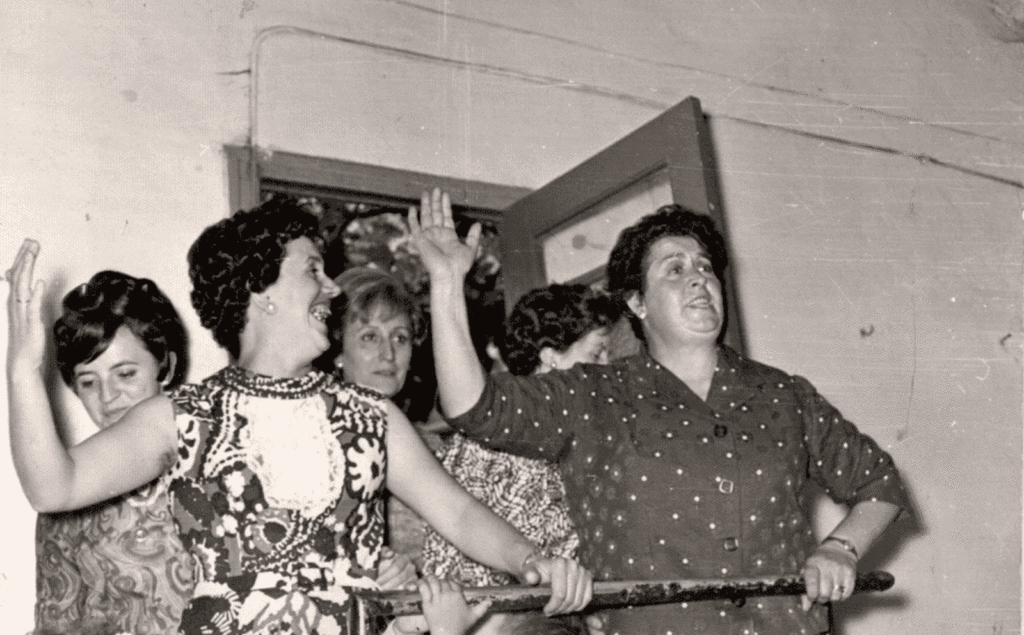
The day Mari Luz met Julio Martínez de Lahidalga, nothing was planned as it happened. It was the Leorza festival. That day, the girls from Atauri were going to see a movie in Santa Cruz, but her parents wouldn’t let her go.
Instead, they allowed him to accompany Blanquita, the parish priest’s sister, to Leorza, where they arrived on foot, as was almost everything done back then.

As fate would have it, a huge storm broke out that afternoon, preventing them from going home to sleep. It was the first time she had gone out dancing after dinner. She still remembers the thrill of sleeping in a different bed.
At 15 years old and still wearing socks, “you didn’t take them off until you put on your stockings,” nothing prevented her from meeting Julio and a love at first sight blossoming between them that has kept them together all their lives.
“We had nothing, just a busy road, which we drove up and down, but we had fun, and if one day a truck driver said anything to us, we would laugh all afternoon.”

Always attentive
Mari Luz and Julio married in 1959 and went to live at the factory until she became pregnant. There, their eldest daughter, Ana, was born, followed later by their second daughter. In 1963, they moved to Maeztu. Julio’s parents had built the house there where Mari Luz lives today.
They settled downstairs and the young men with the girls upstairs.
In 1982, her unmarried brother died, and her parents were left so isolated in Atauri that a return to the banks of the Ega River became inevitable. Twenty years later, when her parents died, they reclaimed their home in Maeztu. “That’s how my life has been: caring for my daughters when I was young and for my parents when I was older. I don’t regret it.”
She has also taken care of her grandsons and granddaughters, something that makes Olatz feel very fortunate.

The Vespa and the 600
Julio had a Vespa. It was the means of transport they used most, even with the two little ones between them, to go from Atauri to Maeztu and back.
One day Julio suggested she take him for a ride to run errands, and she did. But she was so frightened that she went back to her seat and never dared to do it again.
She was the first woman from Atauri and Maeztu to wear trousers. They were brown and made of cloth. She also bought a helmet. They even went to Madrid on that Vespa to buy their first car, a 600, “because it was said that in the north the undercarriages of cars were more damaged.”

Bell ringer in Maeztu
Mari Luz is now a woman in her eighties who looks well. With age, she has become the bell ringer, chaplain, and takes care of everything at the church in Maeztu.
She helps dress the altar, reads, attends pastoral meetings, and rings the bells with a switch, not like in the old days. Today, hardly anyone goes to Mass, only the elderly, but she remembers when you had to run to the second peal to get a place.
That her granddaughters and grandsons do not fulfill the sacraments is not something that frightens Mari Luz; she doesn’t like it, but she knows that life has changed, and she has adapted to the changes with wisdom and respect.

The model trains
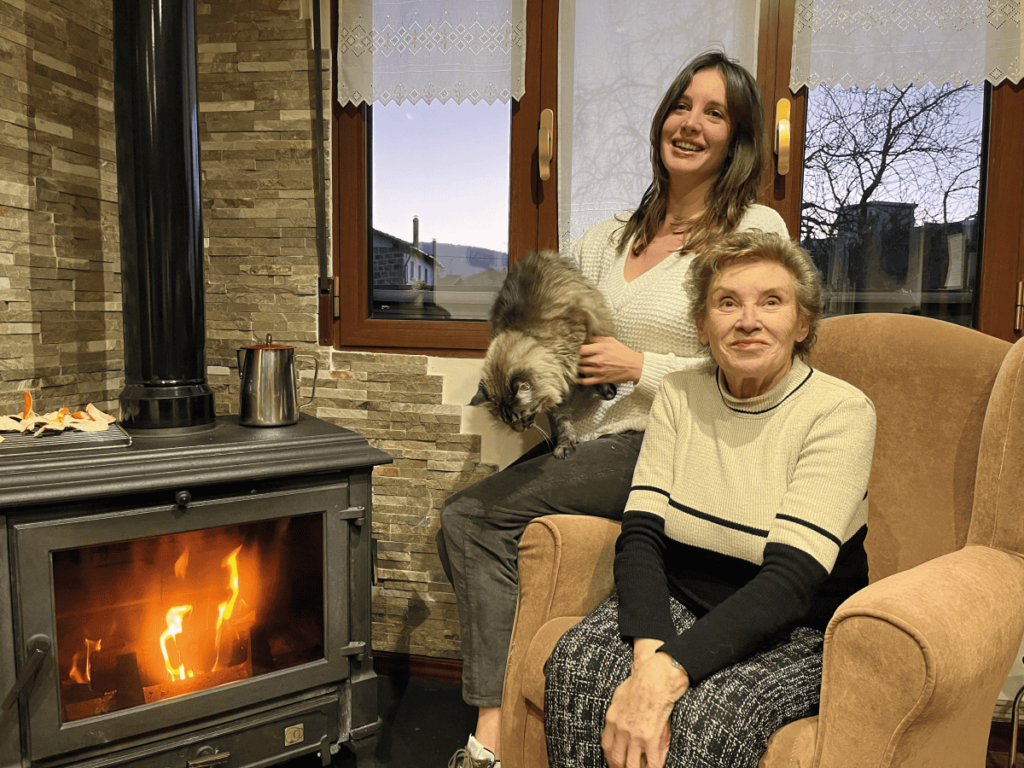
Olatz Ruiz de Alegría Martínez de Lahidalga has lived with her grandmother and grandfather. She grew up watching Julio, a true handyman, build models of the Basque-Navarre railway stations and spent weekends with Mari Luz at the river in Atauri, trying to catch chipas, which were similar to small trout. “We never caught a single one, but they kept us entertained all afternoon.”

Now the two of them live in Maeztu, where Olatz is a teacher and has her own family. Here, her partner, Luis Parra, raises happy chickens in small coops, has a vegetable garden, sheep, and tries to manage his own production, which he then sells between the capital city of Vitoria and through a laborious door-to-door sales process.
Life is very good here, without needing to go to the city. There are two bars where you can socialize, but Olatz especially likes meeting up with her friends at someone’s house or at El Potro, the txoko (a traditional Basque social club) in the village, which they can reserve and use for one euro.
It’s a nice way to give new life to the place where horses used to be shod.