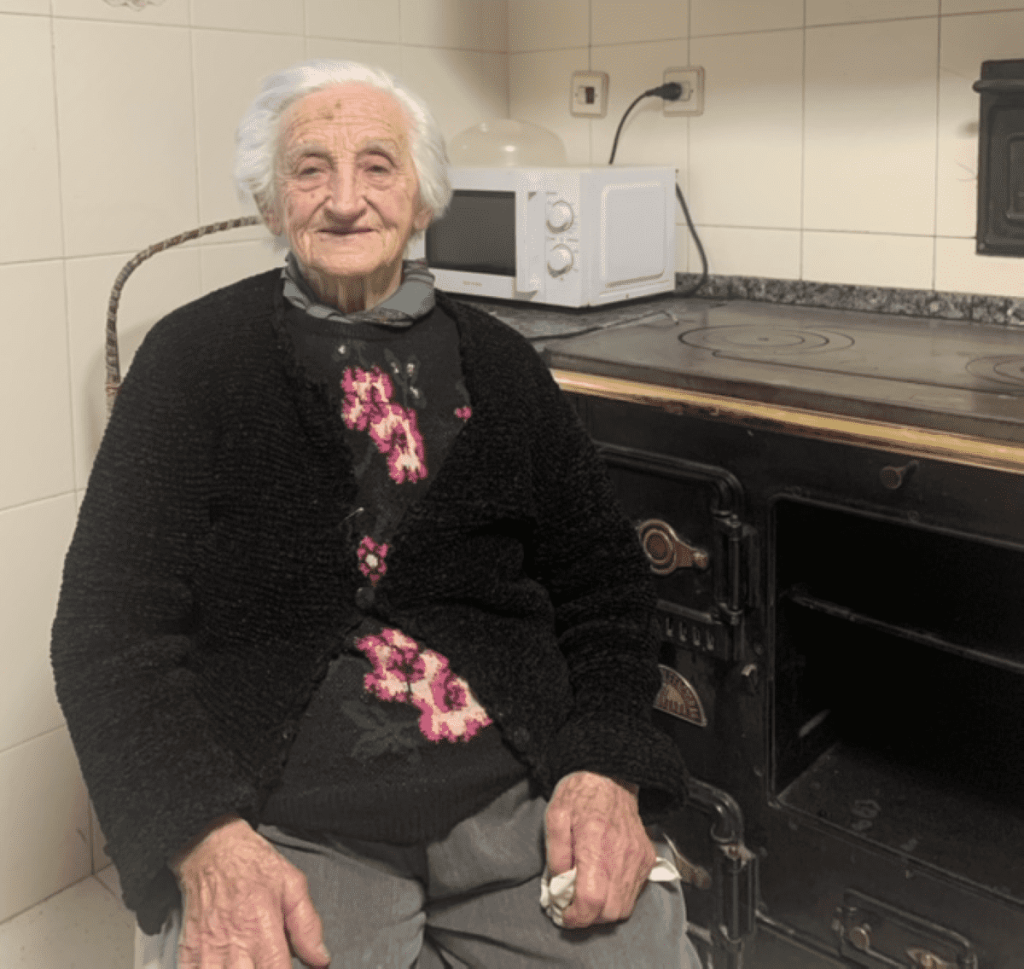
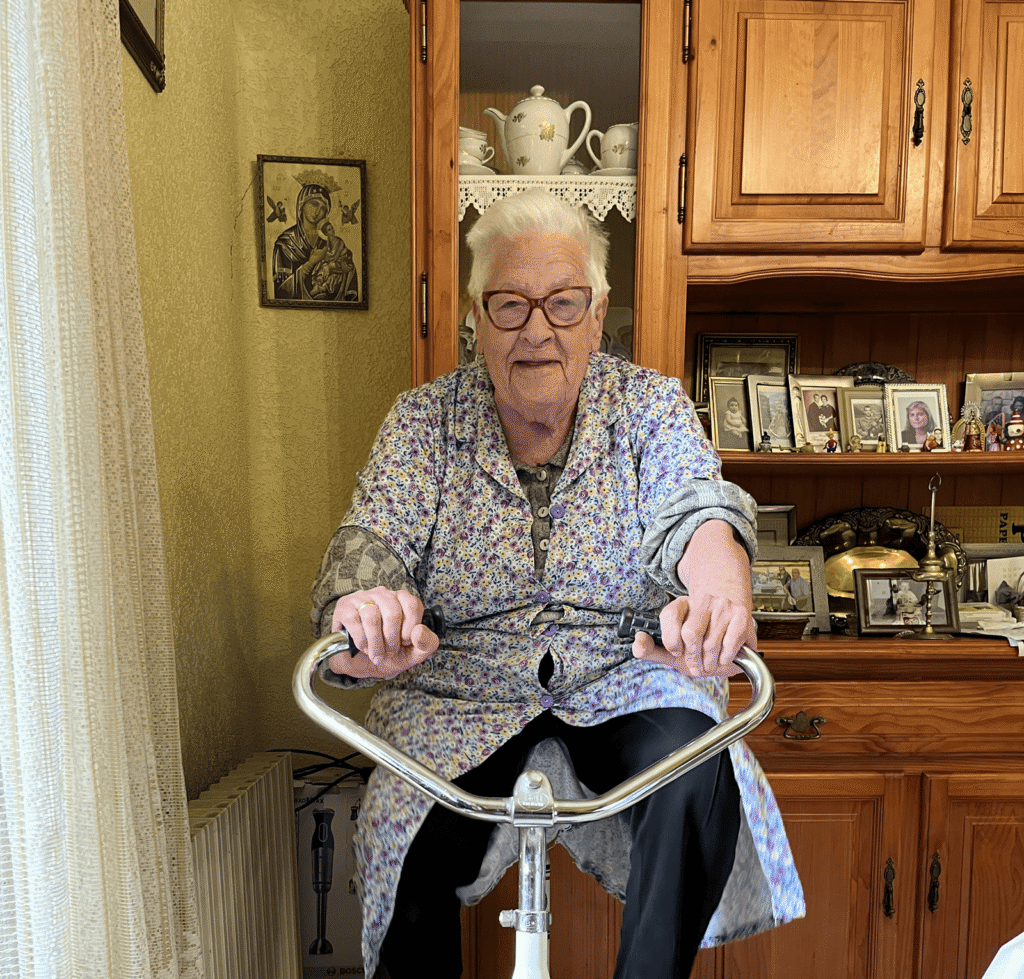
Victoria Palacios is a bit like Oyón, her hometown; she grew up with it, learning to take advantage of its strengths. Vitori was born the first of a long line of women, into a family that taught her above all to work hard and get ahead as best she could, at a time when Oyón was also trying to carve out a prominent place for itself in the wine and commercial world.
From childhood she learned to work in the fields alongside her father, and the grape harvest was a family affair, everyone pitching in. “I cut bunches of grapes with a knife and a razor. I knew exactly what it was like to remove the remains and tread the grapes,” she recalls.
And if she was old enough to work, she was also old enough to have a glass of wine with her meals, something that was normal at home from a very young age, when she was barely 10 years old. It was served from a porrón (a traditional Spanish wine pitcher), and only with meals.

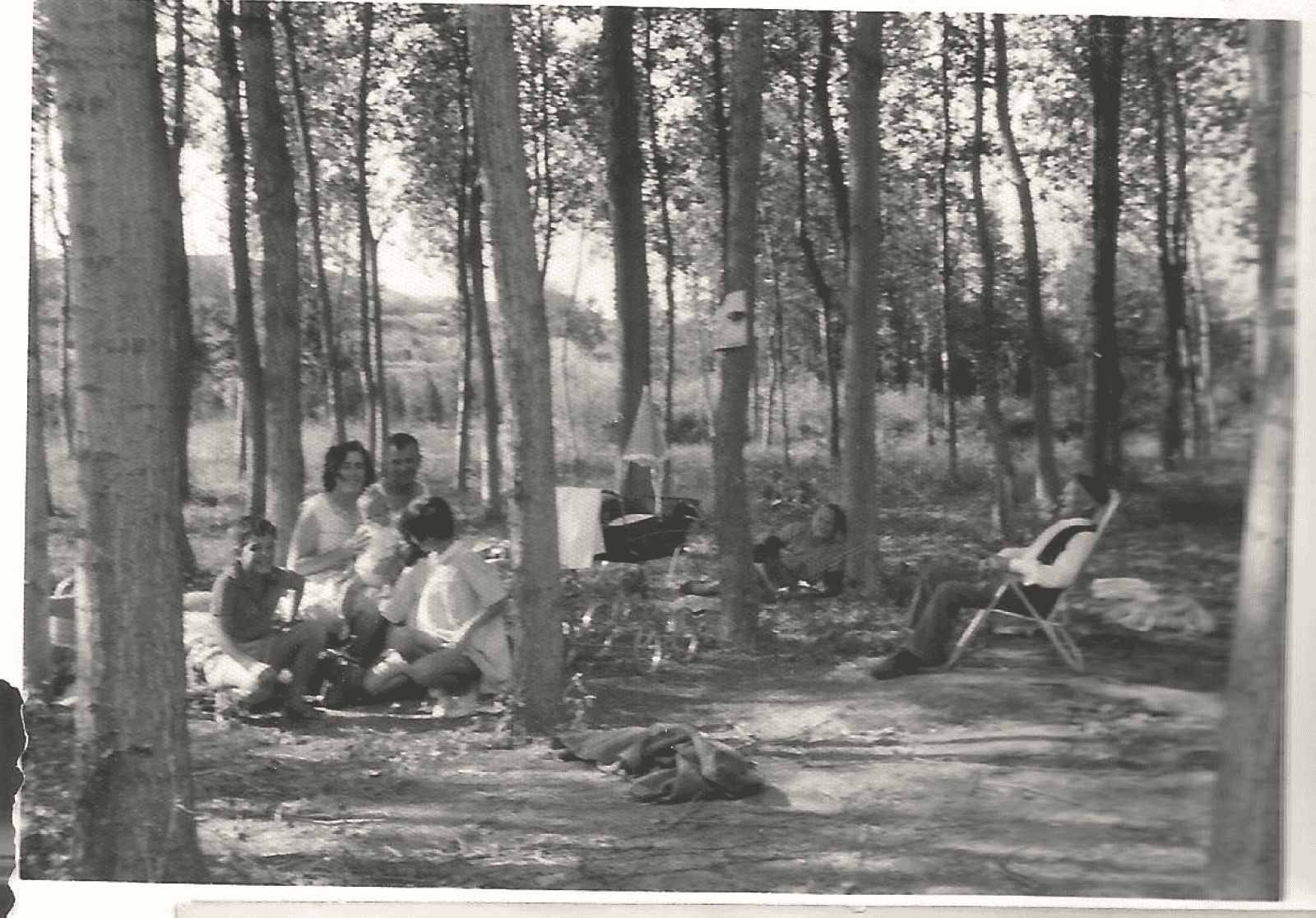
The entire Sarabia family, Vitori’s extended family. Photo provided to the Oyón Town Hall by Álvaro Sarabia.
Wine by the bucketful and soda
The family home was on the same square, three stories high, sustained by the production of the well-known ‘Palacios Soft Drinks’. The bottles were made of glass and distinguished by the town’s coat of arms engraved on them. His brother delivered them; they called him Manolo the Soft Drink Man.
Her father made them in a machine he had at home. The wine was also stored there, and there was a room full of jars for oil.

Family home before renovation. Album familiar.
Another town
The town has changed a lot in these 92 years of Vitoria. Before, the entrance to Oyón was majestic, with poplar trees shading both sides of the road. Back then, they would walk the 5 kilometers to Logroño. They would go down the main road and usually meet at the gates to walk back together, boys and girls. Their loyalty is to Álava, but for practical reasons, they have always gone to Logroño.
Today, it’s the factories that greet visitors. Industrialization began in the 1960s, and people from outside started arriving—”foreigners,” Vitori calls them. “The real Oyón, your Oyón, is dead and buried,” her grandson, Álvaro Sanabria, confirms. No one leaves their keys in the door anymore, as they did when she was younger.
His grandfather had already predicted it. When the new cemetery was being planned, he didn’t hesitate to advise the authorities not to build it in the town itself, but to build it further away, because the town was going to grow downwards. Nobody listened to him, and today Oyón has two cemeteries; they’ve had to build a new one further away towards Moreda.
Coats of arms on the facades
Vitori didn’t stray far from her parents’ home when she married a local boy at the age of 26. In the main square stood a house with four apartments, two attics, and stables—one of those old-fashioned houses adorned with a beautiful coat of arms on its facade.
They settled in one of those houses with a balcony overlooking the square, and in the stables they opened a grocery store. She stopped working in the fields to dedicate herself to selling all kinds of food and cleaning products behind the counter, while Tomás, her husband, continued working the land and at the Salcedo chair factory, one of the first to be established in Oyón during those years of industrial growth.

Manor house with coat of arms, 1943. Photo courtesy of the Vitoria-Gasteiz Archive. E. Guinea.
Without a very clear schedule, because even though it closed at midday there were always neighbors showing up late looking for something, Vitori sweated and enjoyed this new scene. From there to the dance hall wasn’t far and she loved the music, especially jotas and pasodobles, “but not the txistu they’ve added now.”
She says that life has changed a lot since then, that today there is “libertinism and shameless people, whereas before there was more respect for women.”
Little by little, as the other houses became vacant, Vitori and Tomás bought them up, and today the entire house belongs to her. And the old grocery store is now a wine bar run by her son.

Álvaro on the magnificent organ of the church of Oyón
Organist for Disney
Álvaro Sarabia is a 26-year-old who is remarkable for his commitment to the history of his town, to culture, and to art. He is the organist at Santa María de la Redonda, the Co-cathedral of Logroño, in Oyón, and in many other towns in the area, always at the service of the liturgy, at high masses and funerals.
It all started with Disney and the second Pirates of the Caribbean film, when he was just a kid. He discovered that the Flying Dutchman’s cabin had a pipe organ and that it was closely linked to the afterlife, to spirits and the supernatural. From that moment on, every time he went to church, he’d go up to the choir loft, and there it was: the imposing organ, monstrously large.
Two years later the parish priest gave him the key to the church and since then it has been hours and hours of rehearsal and self-learning; “I haven’t gone to class to give organ lessons.”
Today he is a regular organist in Oyón, plays at solemn festivals in the surrounding villages, and in Logroño, in addition to directing his village choir. However, his true passion lies in the visual arts.

The katxi in action 1989. Vitoria-Gasteiz Municipal Archive. I.Sáenz de Urturi
The Katxi
And besides having a knack for art, he has a special interest in learning the details of history, knowing about the characters that accompany the festivities of the towns around him and giving meaning to that whole imaginary world.

Photo provided by Félix Fernández to the Oyón City Council.
“Katxi is the harlequin, and he deserves respect because of his long history. I don’t like him being called a jester or a fool,” he states confidently. Katxi used to lead the brass bands to entertain the crowds, but his main role is that during the San Vicente and San Anastasio festivals, on January 21st and 22nd, he rolls around at the foot of the town hall and the church to pay his respects to the residents.
He is the richest person in town who dresses as a jester to show respect to the townspeople. He has been appearing since the 16th century and has worn countless costumes. Depending on the country’s political climate, he has even worn the republican colors; now he wears green and red.

The Olive Mill
Olive trees in Oyón have a long history, and those who grow grapes also grow olives. The harvest takes place in December, and the cleaned olives have always been taken to the olive mill. The cooperative that traditionally produced olive oil in Oyón was San Vicente, which closed a few years ago after operating for over half a century.
“The end of the work at the Trujal was celebrated with a party featuring the Trujal ranch, a dish made with potatoes from the Alavesa Mountains, cod from Bermeo, peppers from the Oyonesa orchards, and a generous splash of new oil.”
“OYÓN The town that arose next to the ancient spring”
Manuel González Pastor